
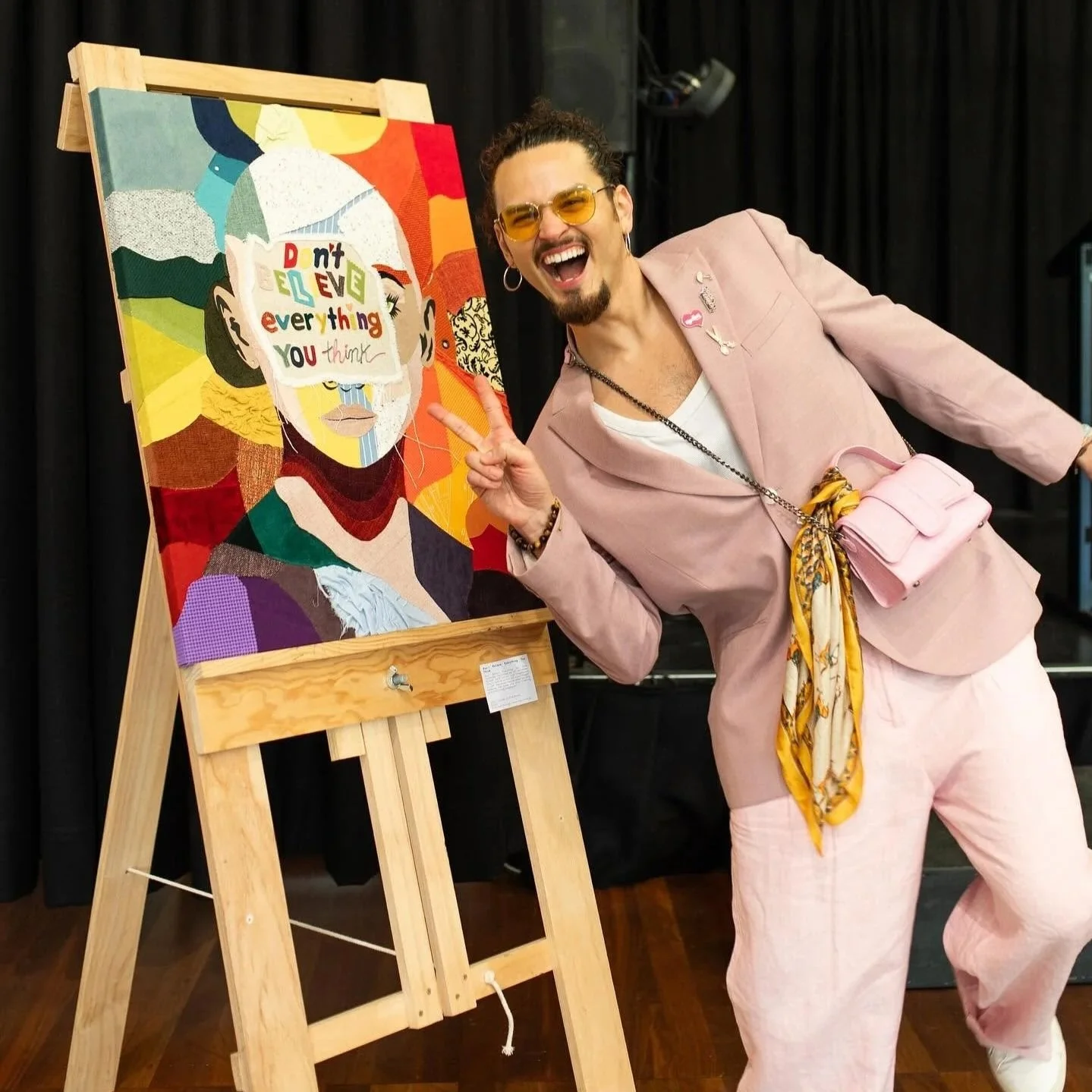
Hailing from his vibrant hometown of Assaré, in Northeastern Brazil—where cultural traditions and a rich artisanal heritage coexist alongside enduring colonial legacies and semi-arid pastoral landscapes—Oscar Arrais’ experiences of environment and culture, loss and love, weave their way through his unique reclaimed textile collages.
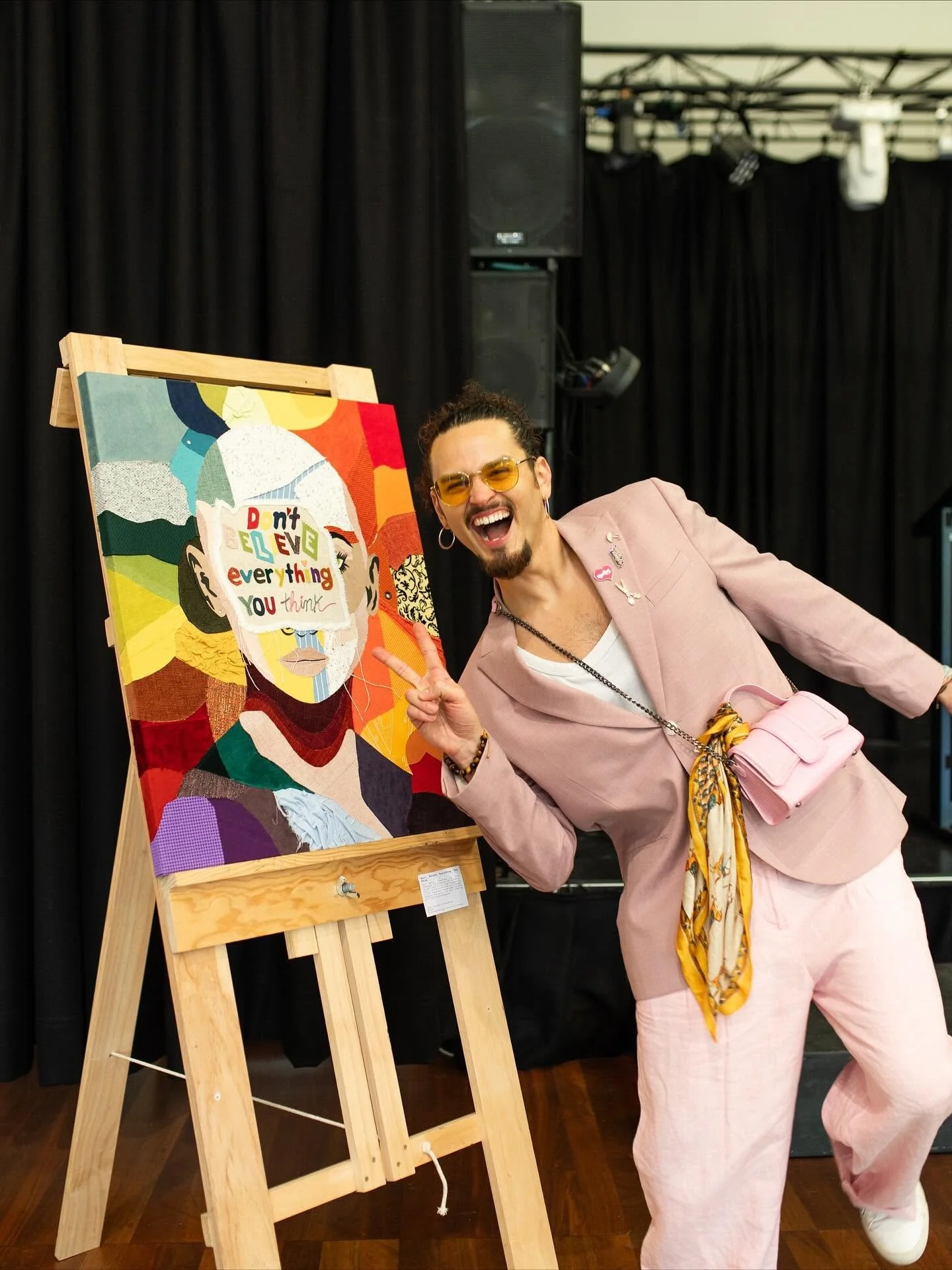
Oscar was the 2025 Feast Festival program cover artist.
What is Oscar’s first memory?
Observing his grandfather, on horseback, carrying out tasks around his farm (a harsh and challenging environment, located 500 kms south from the capital city of Fortaleza). As a boy, Oscar was struck by the transformative power of the rain, when the parched landscape turned lush and green.
How might this first memory have influenced Oscar’s artistic journey?
While Oscar doesn’t believe this memory was the single formative catalyst of his art, there does exist a resonance, whereby he will frequently bring aspects of nature into his textile collages. This was recently expressed in his “30 Birds in 30 Days” project.
When asked if his Grandfather was a “hard man” (an assumption jumped to by the interviewer given the harsh nature of his Grandfather’s livelihood), Oscar said his Grandfather was the opposite; he was a very funny man, always coming up with jokes.
He’d make young Oscar laugh by putting a hat on a cat or a bow-tie on a dog. This aspect of his Grandfather’s whimsical humour has, perhaps subconsciously, weaved its way into Oscar’s work.
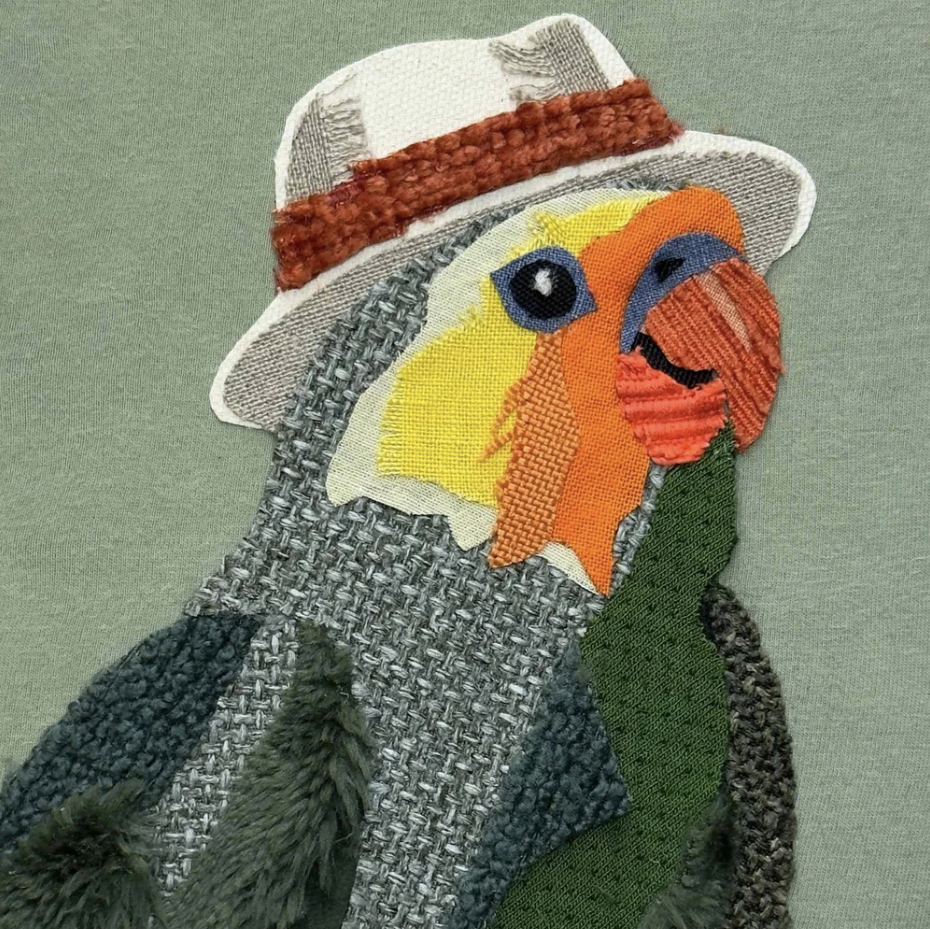
Papagaio, Oscar Arrais.
How long has Oscar been a Mill resident?
Oscar joined The Mill in September 2025. Prior to this, Oscar was working out of his bedroom; this separation of space, between home and work, has had a positive impact on his creative practice, not least of which he can now go to bed without having to shift aside piles of reclaimed textiles!
What is Oscar’s preferred creative medium?
Textiles are Oscar’s favourite medium, making up 95% of his work. He is also dabbling with leather and honing his leather cutting skills. He also uses suede. While he is not vegan, Oscar is mindful that leather/suede are a byproduct of animals that have been slaughtered and, it is with this conscious awareness of their unwitting sacrifice, that Oscar would rather repurpose than throw away these materials.
How long has Oscar been practicing his art?
Oscar first began painting in 2020. In 2022, he switched to textile collages, influenced by the wastage he witnessed during his part-time job (while studying) at a high-end furniture store where discontinued material swatches were simply discarded in the bin. He began reclaiming these beautiful textiles and taking them home. As his artform experimentation grew, friends began donating materials to him.
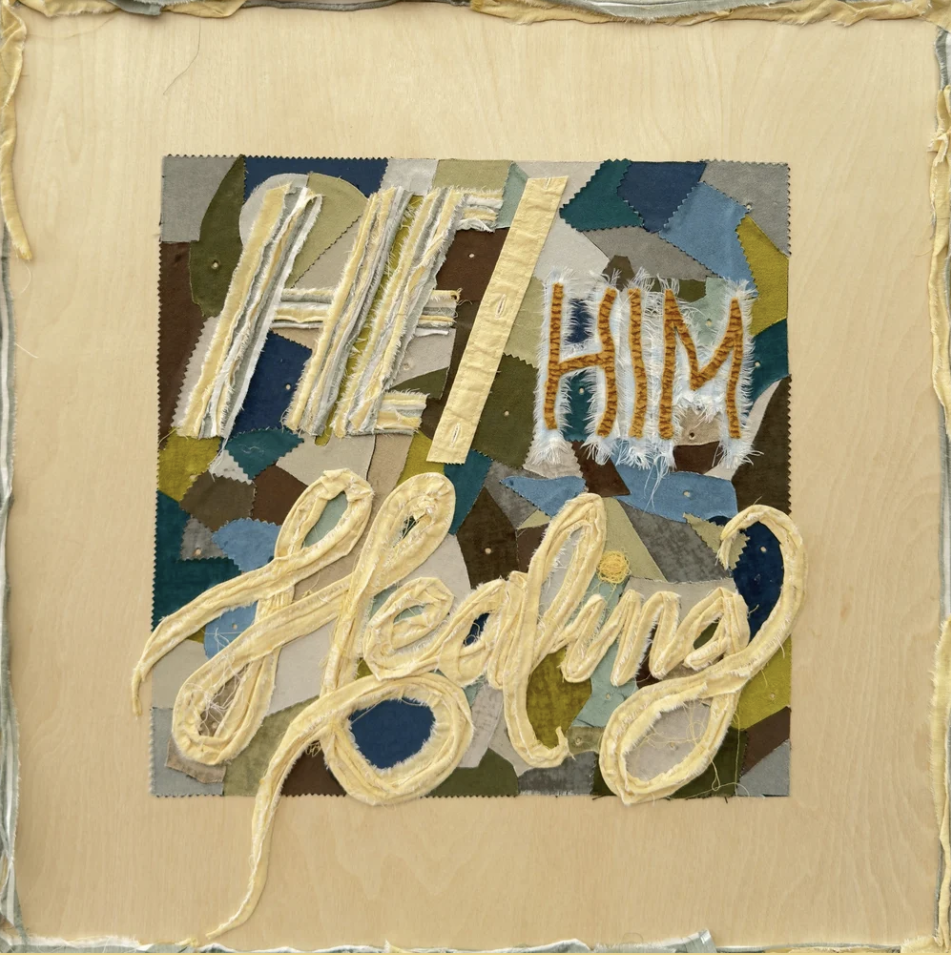
He/Him Healing, Oscar Arrais.
How does Oscar’s Geometry, IT and Architectural backgrounds influence his art?
While studying architecture in Brazil, Oscar received a one-year scholarship at Adelaide University. On completion of his scholarship, he returned to Brazil only to find himself drawn back to Adelaide, to study Interior Design at TAFE’s Tonsley Campus, where he graduated with an Advanced Diploma. He returned to architecture at UniSA but two years into his study, he could not see himself working as an architect.
This realisation coincided with the 2020 Covid pandemic and a seismic relationship breakup. Following his heart, he decided to drop out of study while simultaneously working on his health and wellbeing after the end of his significant personal relationship.
He is cognizant, though, of the resonance between the sharp shapes of technical drawings (such as floor plans) and the hard edges of his paintings and work with tape, while his geometry/architectural background influence the geometric artwork style of his material collages.
Parents are not supposed to have a favourite child. Is this the same for Oscar’s art creations? Does he love them all equally or does he have a favourite?
Oscar does not profess to feeling this way about his art. Each piece comes from what he is feeling at the time, so (like feelings) it is hard to choose one that is more valid than another.
For each piece, how does the creative journey begin? And how does Oscar know when a piece is complete?
After deciding on a concept, there are then three stages in the production of a collage piece. The first is setting up the foundational background: blocking areas for the composition of the piece.
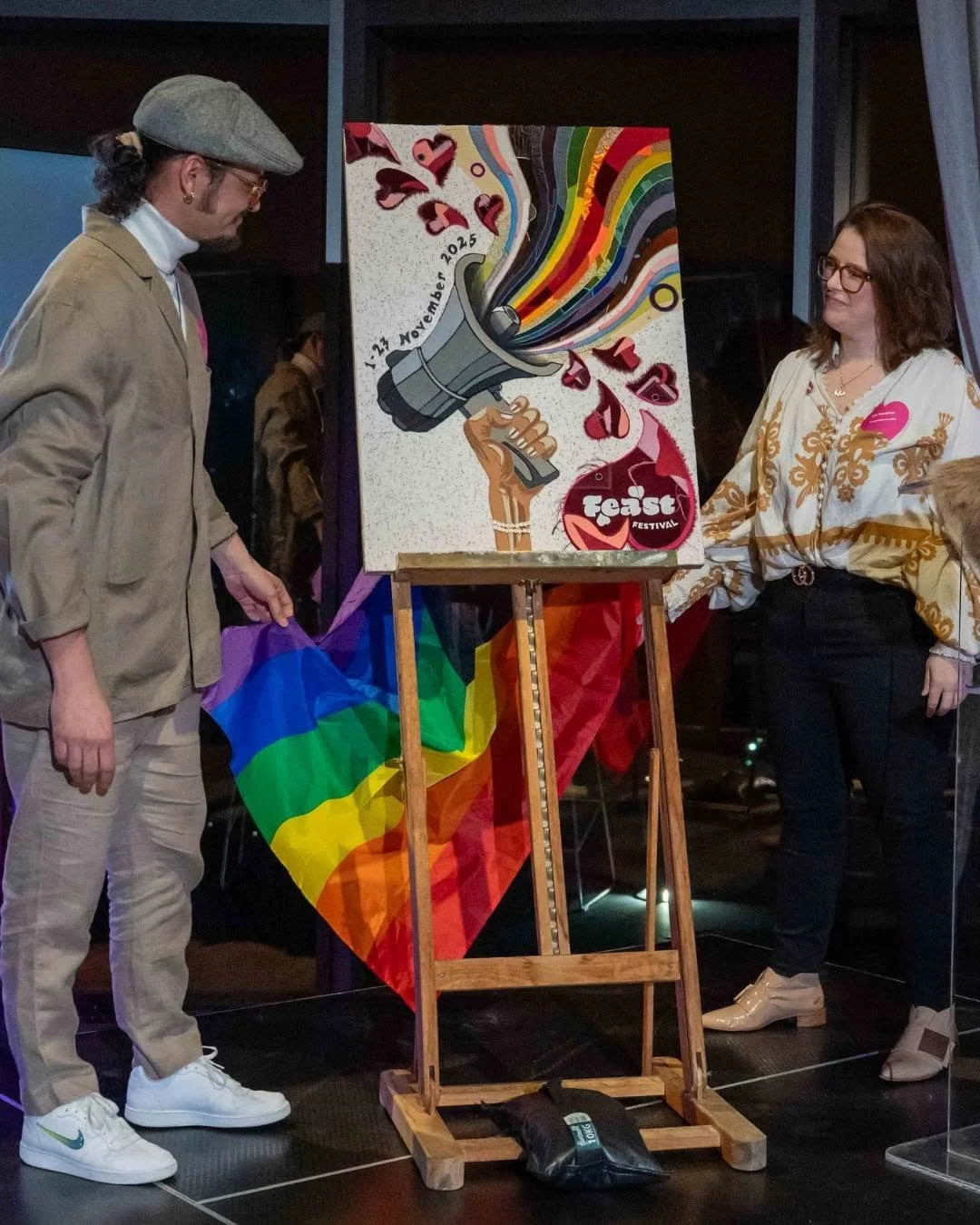
The Feast Festival 2025 program cover. Photo: Naomi Jellicoe.
After blocking out the areas, Oscar next drills down on the details, identifying colours, textiles, and quantities. Then begins the layering process. This is where he has mastered the art of self-control—it can sometimes be hard to stop adding and layering—but over time he has learned to trust himself as to when it’s time to put a piece aside.
Advice for aspiring Artists?
Just do it! Go after it!
Trust yourself – if it feels natural, keep doing it. You will figure out a way to make it happen. You will figure out how to make a business out of your art. Don’t let fear hold you back. If you are an aspiring young artist and fear that your art is “bad”, keep going! This is how you’re going to get better in your chosen medium. If you don’t keep making things, then you don’t have a space to improve.
What Next?
Oscar is now in a very positive place where he feels brave enough to leave his current employment. From June 2026, Oscar’s focus will be building his business and career as a full-time artist.
Oscar is also actively finding ways to recycle textiles, experimenting with shredders to transform fibres into a more malleable material or textile mache. He is passionate about reducing waste by 100%, exploring sustainable methods to dispose and repurpose.
Watch this space!
Words: Margot Albrecht
Artwork images: Oscar Arrais